Soon after the unlawful killing of a Black person, it’s not uncommon for white people to share images of a little white toddler and a little Black toddler holding hands or playing together in a sandbox. The caption is usually along the lines of “We aren’t born racist. We learn it,” or “We were born to see people, not the color of their skin. We learn that prejudice along the way.”
But this is false. I, as a white woman, can say that I was born racist. I can say that I continue to be racist. This is because the system of racism was pervasive before my conception and continues on today, and I have benefited—and still benefit—greatly from that system.
I don’t remember the exact moment when I realized all people don’t look like me, but I learned it. Growing up with my sister partially taught me this lesson. Many people saw her dark eyes, dark hair, and olive skin and asked my mother if she had a different father. Surely, we couldn’t be full siblings; she with her dark features and me with my light eyes and skin. I learned about the attention our differences garnered from strangers. I learned it was ok to ask such questions and make such assumptions.
I don’t remember the exact moment I learned the n-word, but I learned it. I imagine I was in elementary school. I also believe that I must have said it a few times, curious to try it out and understand its power. I learned the n-word around the same time that I learned “shit” and “damn.” I internalized it as just another “bad” word that you don’t say in front of adults.
I don’t remember the exact moment when I learned why to never say the n-word in any context, but I learned it. Someone or something had to teach it to me because I was not born with the innate ability to know not to say it. I was born racist and had to learn this lesson, arguably after I had already harmed someone.
I don’t remember the exact moment or lesson when I finally absorbed what white privilege means and stopped fighting against it, but I know it wasn’t until college. I made it all the way to 18 years old thinking I had struggled and suffered just as much as everybody else, and that surely, I could not be a racist, for I had read Frederick Douglass in high school.
While there are plenty of moments in my education that I don’t remember, there are just as many that I do remember. Moments that I am still unpacking and trying to un-learn.
I remember learning that the Black kids in my first-grade class had names that were hard to pronounce and harder to spell. I remember learning that it was ok to ask them for a shorter nickname. That’s what the teachers did, so it must have been ok. That was my privilege speaking—the one that makes me think I’m entitled to an easier life.
I remember one classmate, Dante, wearing FUBU jeans to class in third grade. I asked him what that meant, and he told me: “For us; By us.” I remember thinking, “Does that mean I can’t wear them? Why not? That’s not fair.” That was my privilege speaking—the one that makes me think I’m automatically entitled to everything.
I did learn to never say the n-word in any context—ever. The way I learned about the n-word and the way Black children learn about the n-word are on opposite ends of the knife. Someone had to teach me because it was never used as a weapon against me. That was my privilege speaking—the one that makes me think I don’t have to learn or confront things unless they affect me directly.
My privilege continues to show up and show out, day after day. That is not something I will ever be done unpacking or fighting against. Just like my racism, I will never arrive at some magical finish line where I get to wear an award ribbon that says: “Not a racist anymore!” That’s a myth that too many white people like me buy into. If we just block one more terrible uncle, if we just read one more article, if we just post one more supportive post or comment, if we just say one more apology, then we must get there eventually, right?
Wrong.
I know that I don’t get to take any days off from this work because Black people and people of color never get to take a day off from the oppression they suffer. I know that every time I do get lazy or forgetful or distracted from this work that I am being harmful and toxic to Black people and other people of color. I know that those moments will come and that I will have to apologize, ask for forgiveness, and then double-down and work harder to right those wrongs. I know that I cannot expect Black people and people of color to do this work for me. I know that every time they do help me, I owe them for their time and labor. I know that I will have to get comfortable being uncomfortable. I know that I have so much more to learn. I know that I will never know enough. I know that I will never fully understand. I know that I cannot feel the same pain or anger or exhaustion as the communities who are held firmly under white oppression. I know this entire post is centering my experiences over the experiences of Black people. I know the very action of sharing my thoughts and reflections is an act of white entitlement. I know I will make mistakes. I know it’s on me to learn and grow. I know that this is just the beginning of a journey that will take me to my dying day and that my dying day will probably look very different from the dying day of many Black people in my country.
Glennon Doyle writes in her book Untamed, “I could not think of a single thing I was more terrified of being called than a racist.” She goes on to conclude, “The worst thing is privately hiding her racism to stay safe, liked, and comfortable while others suffer and die. There are worse things than being criticized—like being a coward.”
Here are a few ways we (white people) can engage and prevent further cowardice on our part:
- Social media action is a start, but it’s not enough! Remember that awards ribbon is a myth.
- Research local social justice initiatives—especially ones led by Black people and/or people of color—and donate to their organization. Even $10 here and there can go a long way!
- Get on the phone and call politicians and community leaders to demand change and justice.
- Audibly and visibly protest the killings of Black men and women in our communities. Make signs that say, “END WHITE SILENCE” and “BLACK LIVES MATTER” and stand outside your local police department where they can’t miss you.
- Get in the faces of racist friends and family members and shut them down or go down trying. Remember that, no matter how exhausting it gets, we cannot stop fighting.
I am asking you to hold me accountable, too.
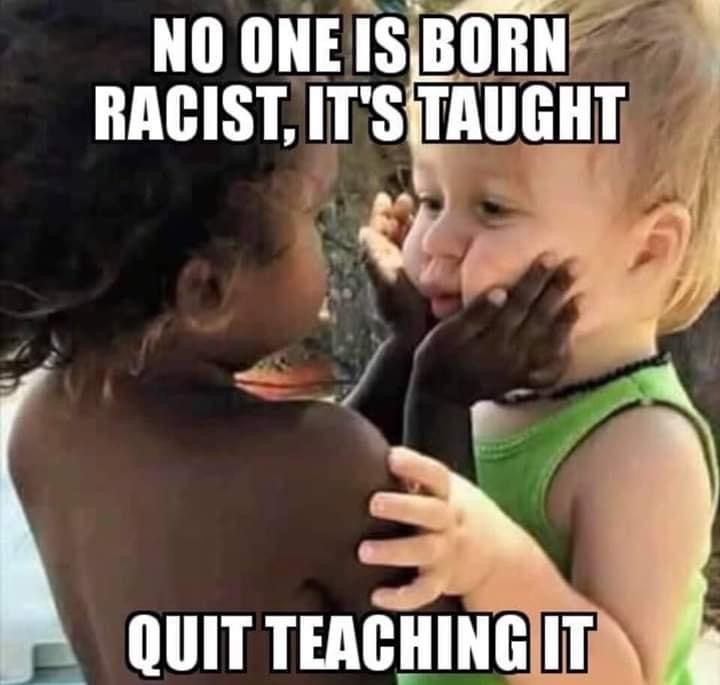
(Image shows a Black toddler and a white toddler embracing with text that says, “No one is born racist, it’s taught. Quit teaching it.”)
 (S)words of Healing